Zusammenfassung
The author reflects on their evolving relationship with Munich's Forstenrieder Park, contrasting its established beauty with the younger Perlach Forest. As personal priorities shift from urban excitement to natural tranquility, a growing awareness of the challenges surrounding forest preservation emerges.
Diese Zusammenfassung wurde mit KI-Unterstützung erstellt.
Yes, I know. I need to restrain myself a little; I mustn't get too euphoric. Because wherever great joy arises, the first setback is bound to come around the corner soon. And even in great love stories, the small or large problems are often conveniently ignored. We all know them—the famous rose-colored glasses. But fear not, I put those aside long ago. We are all aware of the problems facing our environment. I don't want to get too romantic for that reason. Because on the one hand, my text is meant to be a declaration of love, but on the other hand, my sense of alarm is steadily growing. I am learning more and more that preserving forests is a massive challenge.
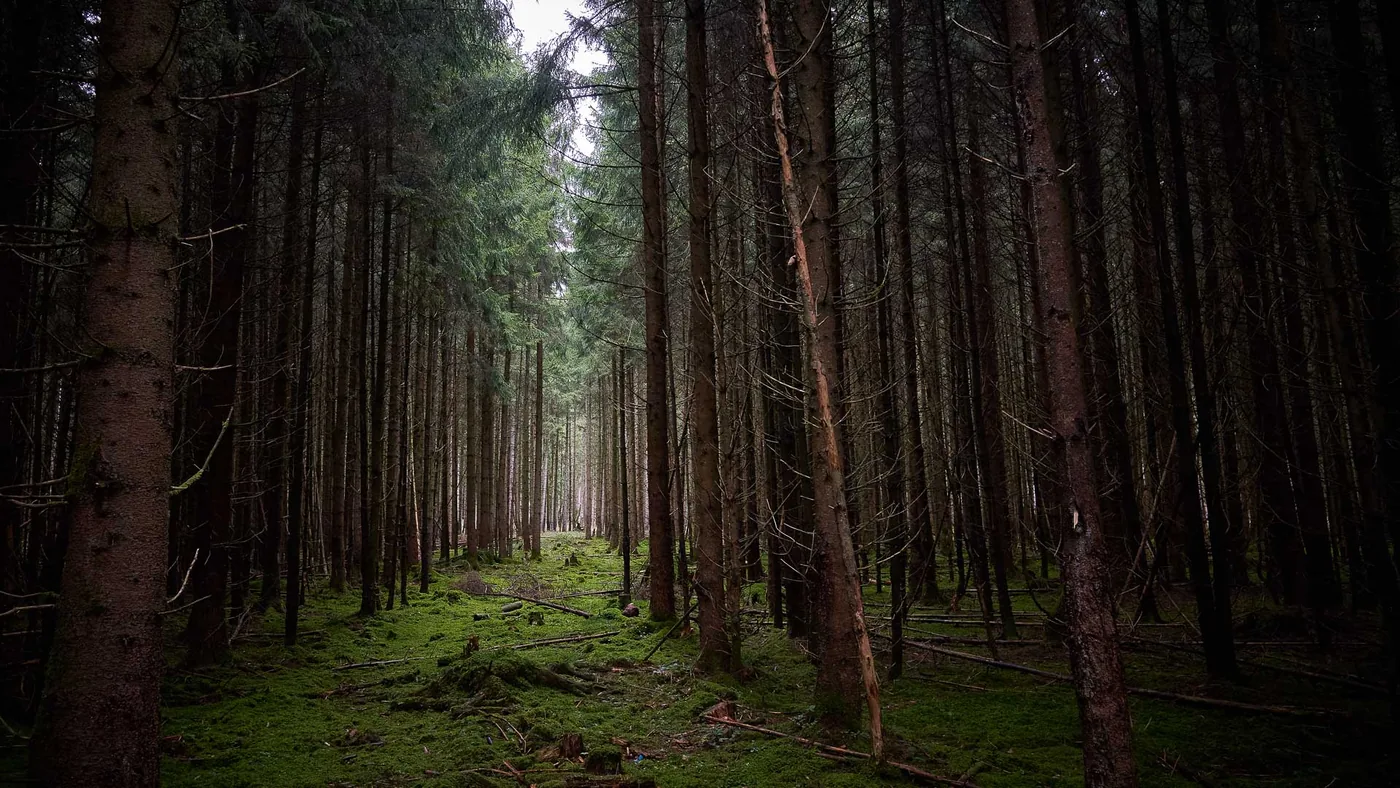
In my immediate vicinity, I have two forests. On one hand, there is the Perlach Forest, and on the other side of the Isar, the Forstenrieder Park. I like the Perlach Forest, but the destruction caused by storms and the fact that the trees are rather young compared to the Forstenrieder Park always make me look enviously across the Isar. Consequently, I spend a large part of my photographic activities in the Forstenrieder Park.
It was, or rather is, a love that came on the second glance. I have lived in Munich for over two decades and, of course, knew the forest. However, in the early years, it was simply just a forest without any special significance to me. It was still the time when, as a young guy, I was drawn to the city, where the action happens. It was also a time when Gärtnerplatz didn't play much of a role yet. There were other places where young people liked to be—places where there was hustle and bustle. Now, at nearly forty, things are changing enormously. I am increasingly seeking the peace found in the forests. Much like how I spent my childhood and youth as a boy in the village. At that time, the forest was a given, nothing special. It was just there. And environmental protection? Not a topic. Back then, forest paths were still filled with old bricks, garden waste was disposed of in the thickets, and somehow everyone did it and nobody minded. Unthinkable today, but a common occurrence back then.
Many years later, things have become dramatically different. We are confronted daily with words like climate change, environmental protection, but above all, with themes like destruction. For me, these topics are often a bit too abstract—important, no question—but sometimes too far away. We advocate for 1.5-degree targets, yet at the same time, it seems impossible for us to keep nature clean right on our doorstep. Added to this is that our society is becoming increasingly fast-paced, while the desire for retreat and relaxation is rising. Our forests are confronted with all of this. Because relaxation has to happen somewhere. And in the midst of it all, there are the animals that live—or must live—within them. For them, the forest becomes the only sanctuary, because the habitat outside is constantly shrinking.
The Forstenrieder Park is so special because red deer and fallow deer populations have been managed there for decades. However, the park is primarily known for its herds of wild boar. But once you have seen a red deer stag, the sight never lets you go. Especially during the rut. Last autumn, I walked along the paths or cycled along them particularly frequently. Every now and then, I would stop, because the roaring of the stags sounded breathtaking!
In the early morning, when the mist is still drifting through the trees, when everything else is silent and there are no visitors* in sight for miles, the forest reveals everything. Then nature can be experienced in all its power. Just to put this in perspective—I am telling you about a forested area on the outskirts of a city. That is precisely why the experiences there have an even greater value for me. In the mountains and away from civilization, the experience might be even more intense. But how many cities have an experience to offer like here in Munich?
Where else can you encounter wild boar at the side of the path, while fallow deer and red deer also occasionally stroll across the trails? At the same time, visitors are cycling along the paths, office bags strapped to the back of their bike racks. Not a bad experience for after work, right?
I see many people who simply stop, park their bikes, sit on a bench, and just listen to nature. That is how it should be. The Forstenrieder Park is a very special habitat. Preserving this remains a major challenge. We are all called upon to contribute to its preservation. On one side, the Bavarian State Forests (Bayerische Staatsforsten) bear the responsibility, and on the other side, we visitors do.
Economic interests will, of course, still have to be weighed, because in Germany, forests are also a livelihood and must yield returns. I don't harbor any illusions about entirely untouched nature. But there must be undisturbed space for animals, and economic interests must not prevail. Not least because two wildlife sanctuaries were established in the past, in which hunting activities are also suspended. To be honest, outside of the wildlife sanctuaries, I am incredibly frustrated when I see the large clearings cut into the forest. Of course, trees have to be harvested somehow. But I am a layman and am merely noting my observation.
The park will never be left to itself; trees will always remain an economic factor, and the conflict between humans and animals remains omnipresent. What is important is that the people acting represent the right interests. We all have to work together here to ensure the forest does not lose its uniqueness. On a small scale, this includes leaving trash at home and avoiding walking in the forest off the paths as much as possible.
And on the other hand, I appeal to the State Forests not to place the sole blame for browsing damage on the animals. Hunters know their responsibility to handle life in the forest with particular care and to preserve it. On the other hand, we photographers must present the forest as it is. Do not sugarcoat anything; show the magnificent nature, but place the images in the proper context. We too can contribute to preservation, even if our role lies only in public relations. But we must take responsibility and must not continue to live only in the shadows.
So, as you can see, this love hangs by a thread. Nothing is taken for granted, and nothing happens by chance. Much more must be done for its preservation so that this treasure at our doorstep remains intact. Please, everyone, help out!