Zusammenfassung
The Isar river in Munich faces increasing ecological stress due to high visitor numbers and overcrowding at popular spots like the "Munich Gold Coast." A shift toward public education on local biodiversity offers a sustainable alternative to security measures and prohibitions.
Diese Zusammenfassung wurde mit KI-Unterstützung erstellt.
For me, the Isar is one of the most beautiful river landscapes in Germany. My regular walks along the river show me that I am not alone in this opinion. I believe that we Munich residents are in a particularly privileged position to have a river of such quality and biodiversity right on our doorstep.
»The Isar and its animal inhabitants are being subjected to high levels of stress right before our eyes.«
But as is always the case with love, too much of a good thing can become overwhelming. For us, the Isar is a place of retreat, a place to meet friends, yes, even to party, and of course, to swim. And while only a manageable number of people visited a few years ago, the number of sunbathers is steadily increasing, especially towards the city center. That is why I call the areas around the Wittelsbacher- and Reichenbachbrücke the "Munich Gold Coast." This might sound exaggerated at first glance, given that beer consumption often outweighs cheap, hard alcohol. But setting that aside—and this applies to all favorite spots—the more and more often we want to be there, the more these areas are strained, and the Isar and its animal inhabitants are subjected to high stress.
Attempts such as increased security personnel and growing prohibitions are steps taken to counteract the masses, but will these measures satisfy everyone in the long run? Why not start with increased education instead? Educating people about the actual biodiversity that prevails here—that the river does not simply carry cold, clear water, but numerous schools of fish, crayfish, and other animals. Of course, one could argue now that this educational approach won't interest anyone, and certainly not from a top-down perspective. And who can blame people for wanting to end their day there after hard work?
»The Isar is a wild river, not an innocuous stream.«
Education is already happening today, for example, regarding the visible pollution of the banks through (cinema) advertisements requesting that people take their trash with them—or at least place it where it can be collected. Naturally, there are also numerous information boards about biodiversity. These are often ignored for various reasons. Of course, anyone can independently research and inform themselves about the wonderful creatures living beneath the water's surface. But honestly, it has always been easier to bring information to where the people are, rather than hoping they will seek it out.
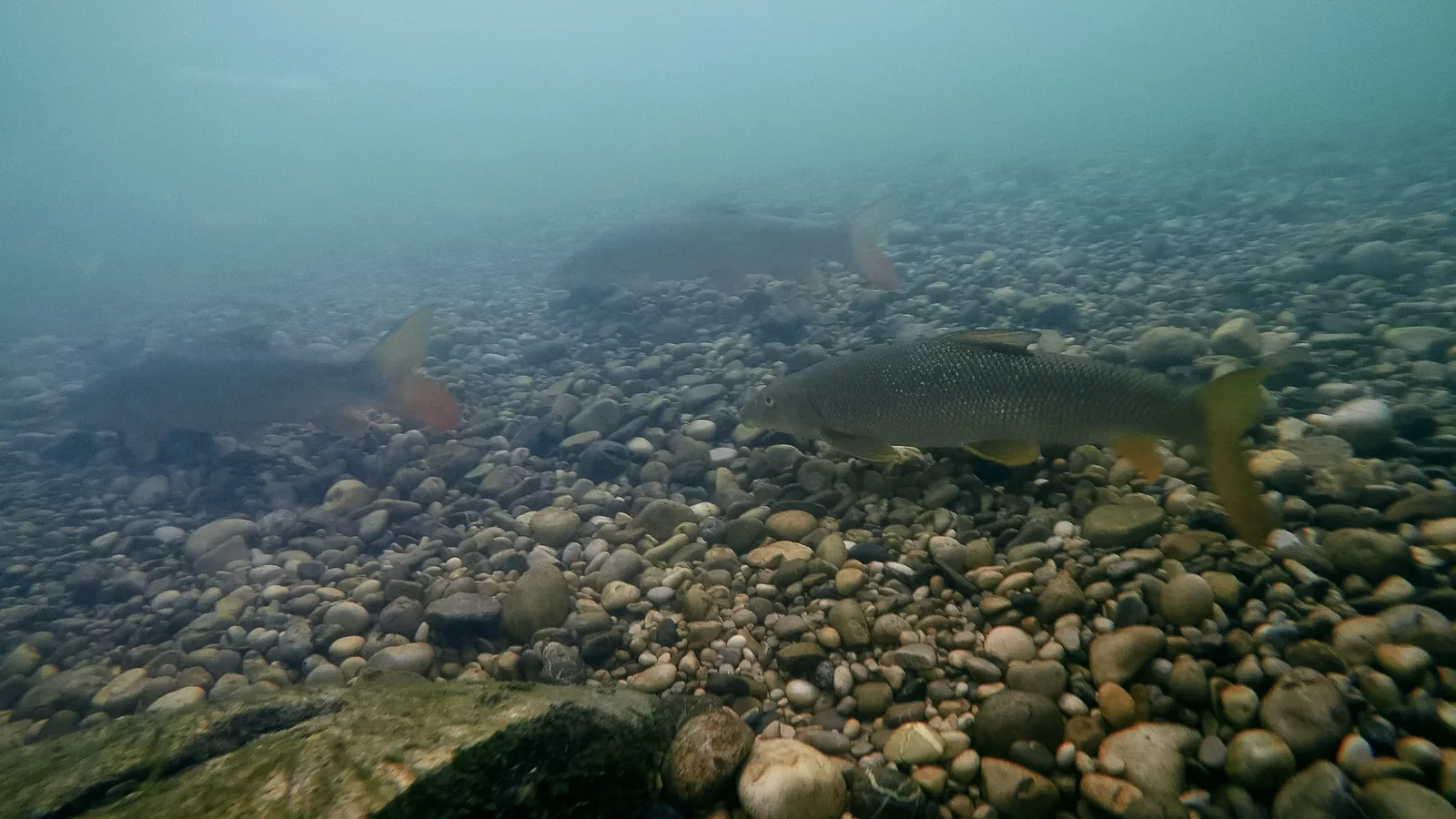
I don't have a magic formula either, but I try to make the Isar emotionally more tangible through film and photography. For anyone who wants it. For five years, I have been regularly visiting well-known spots on the Isar, diving underwater, and letting myself drift with the current. While doing so, I film everything that comes before my lens. This is not infrequently a challenge, as the banks are in a constant state of flux. Where there is a sandy beach today, there might be gravel tomorrow, or the spot might have disappeared entirely.
In the water, you can almost always find spots that are over a meter deep and surrounded by rocks. Young fish, in particular, love these places. Here, one must master the balancing act of capturing life while not being a nuisance. Most importantly: take nothing, destroy nothing, just be an observer. Once you have learned how to hold your position in the current, it doesn't take long before you are surrounded by fish, both small and large. With practiced breathing, you can certainly stay underwater for quite a while and let yourself drift, following the flow of life. But you must never forget that the Isar is a wild river, not an innocuous stream.
»The middle of the river is, as always, unreachable.«
Drifting is always limited to a few meters, and the middle of the river is almost always unreachable. Harmless from the outside, the current reveals its massive strength in the water. Keeping both legs on the ground becomes an art form. This is also a major and difficult challenge for the equipment. The last thing you want is to lose it and thereby contribute to further pollution of the Isar. After five years, I am still just as enthusiastic today as I was the first time. Being underwater is something special, because after just one step, you find yourself in another world.
But the downsides are mounting. While the biodiversity moves me, the trash found during my underwater journeys increasingly shocks me. This includes absurd finds such as a game controller or cans of penetrating oil. Finding empty beer bottles, unfortunately, has become a matter of course. By the way, these finds already appear at the edge of the city. Not infrequently in good company with abandoned inflatable boats. Their owners* preferred to get rid of the cumbersome possessions after a one-time trip and left the boats abandoned on the bank. After the next rainfall, these were washed back into the Isar and drifted toward the next weir. Surely someone will pick them up?
Actions like "Fridays for Future" have shown that the environment is not a matter of indifference to many people. But when we speak of the looming climate change, it still feels somewhat distant in our thoughts. We believe we still have some time and will soon be able to take the necessary precautions. Yet, one only needs a quick glance at the banks of the Isar to realize that we cannot even keep our own home clean.