Zusammenfassung
A photographer shares the patient experience of waiting in a forest to capture images of a black fallow buck. The narrative emphasizes the importance of silence, wind awareness, and minimizing human impact on the natural environment.
Diese Zusammenfassung wurde mit KI-Unterstützung erstellt.
It is a promising Saturday morning in November; I have taken up residence in a beautiful patch of woodland. To be more precise, I have placed my chair in the tall grass, slightly offset in a hollow. Over that, my camouflage cloak, and firmly in hand, my thermos of coffee. The temperatures are near freezing.
This is a good spot! I am certain I will encounter an animal today. How do I know this? My theory is mostly supported by a gut feeling or if I happened to see an animal there on another day, usually while just passing by. Of course, I also exchange ideas with fellow photographers.
When I set up early in the morning—to put it simply, when I sit there and stare into the distance—the desire to encounter an animal is actually misplaced. Because in the best-case scenario, no animal will ever take notice of me.
A wrong step, the snapping of a twig, or the rustling of leaves is often enough, and all animals in the immediate vicinity will retreat, which for me would mean it is time to head home. A brief bit of fun. But it shouldn't really be for selfish reasons. I simply want to leave my footprints as small as possible.
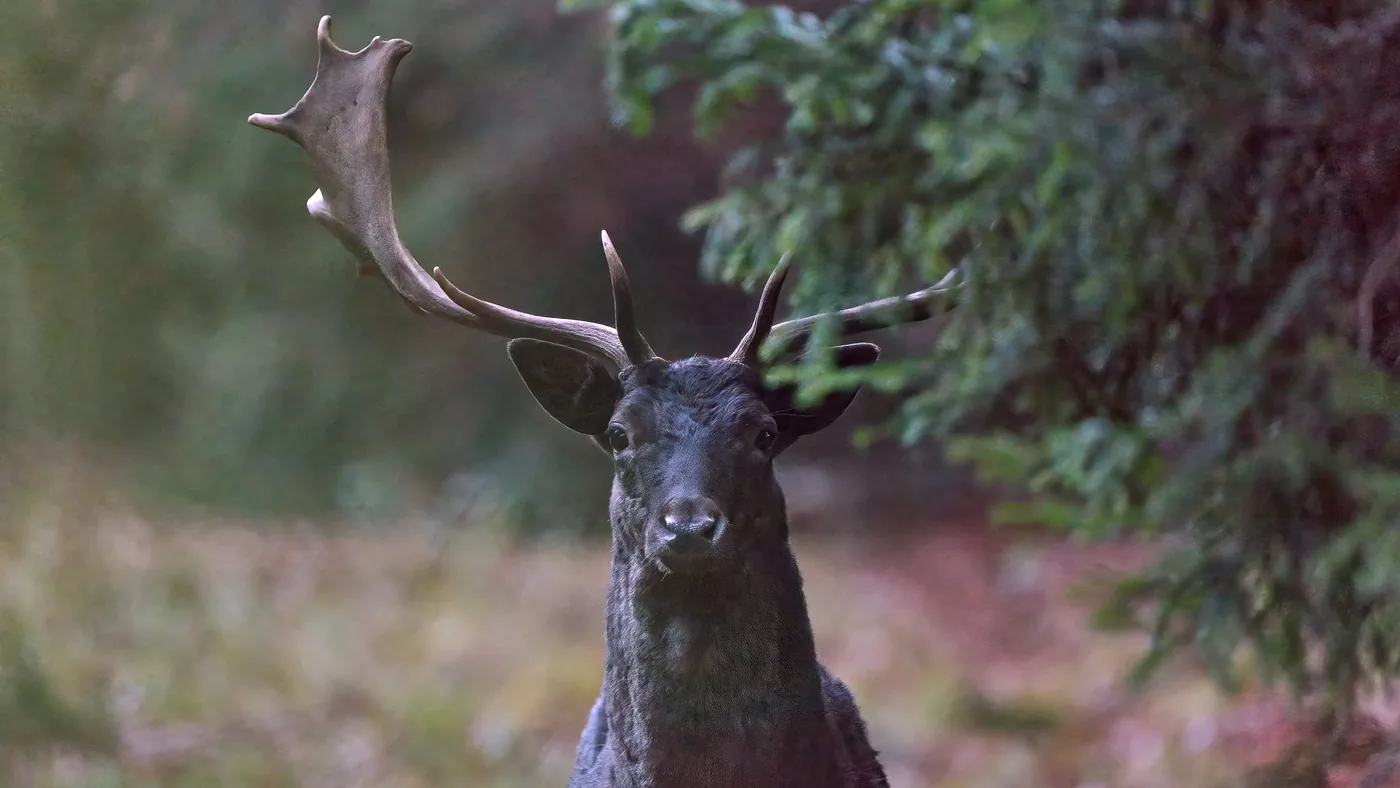
A fallow deer at the edge of a forest clearing.
So, it means being quiet and behaving accordingly, whether verbally or through movement. To do this, I also have to consider the wind, because if I am "incorrectly" positioned, I could wait forever and no animal will ever show its face. Enough with the preparation. This all sounds quite boring now, doesn't it? More like exhausting. But no, it isn't. They are just simple basic rules that every photographer follows. I have written elsewhere before that, unfortunately, some hunters do not attribute these qualities to us at all.
The more often I pursue my passion for photography, the more confident I become in my behavior—yes, sometimes almost reckless. The aforementioned basic rules are important, but at the same time, I must admit that I don't always manage to stay perfectly still. I rummage through my bag from time to time. It is not uncommon that I think nothing of it, look up, and a wild animal like a deer or a stag is standing right in front of me. It remains unbelievable to me how almost silently these animals move. It was somewhat like that on that particular Saturday morning in November.
I had been sitting in the grass for an hour; I was getting bored, and thanks to cell reception, my smartphone distracted me a bit too much. Not for long, maybe just a few seconds. But that was enough. Something scurried past 50 meters in front of me. A fallow deer. In many cases, this is when what should never happen actually happens. It is almost a classic: I press the wrong buttons. Like many photographers, I operate my camera exclusively manually; this is especially important in poor lighting conditions. But since I also use my camera for other purposes, my freely configurable buttons have different functions depending on the setting.
Especially with gloves on, I unintentionally jump exactly to the setting I don't need at all. But that's just a side note. These problems are now solved in fractions of a second, and I know which shutter speed, aperture, or ISO value I need, when and where. The deer scurried across the meadow in front of me, perhaps 50 meters away. Suddenly, it was gone. "Fine," I thought to myself. At least I saw it, but the moment was over quite quickly. Too quickly!
At the very moment my eyes are checking the shots, I see antlers appear out of the corner of my eye and I can't believe my eyes. A stag is standing in front of me, and there are not even 10 meters separating us. For a wild animal, that is damn close. He stands before me, looking curious, breathing audibly, but remaining calm. I try to do the same, adjust the camera accordingly, and press the shutter silently. Again and again. The stag comes a little bit closer, so close that it becomes tight for my 600mm lens. Now it is soon going to be more than frame-filling.
One thing is clear to me now: in this moment, I am truly no disturbance. Not the type who startles animals or stalks them. I am simply sitting there peacefully, observing the scene. At the same time, the stag shows me his curiosity, and minutes later, he simply continues on his way. Calmly and composedly, not running. Without any rush. He just keeps going, and I have captured the best images of all time so far. A moment I will not forget for a long time.